Insanity Experiments at Buchenwald
The Crying of Lot 49The Insanity Experiments at Buchenwald are the history Dr. Hilarius confesses to Oedipa Maas: a program of coercive psychological and bodily interventions on prisoners, conducted under the claim that inducing catatonia might be more humane than leaving prisoners to die. His account makes the episode both a record of Nazi violence and the source of his lifelong, failed effort to believe that psychoanalysis could redeem what he had done.
Purpose and Methods
Hilarius says he worked on experimentally induced insanity. In the liberal SS circles he describes, a catatonic Jewish prisoner was considered as good as dead, and therefore supposedly a more humane outcome. The premise does not soften the violence: it recasts the destruction of prisoners’ minds as an experiment in mercy.
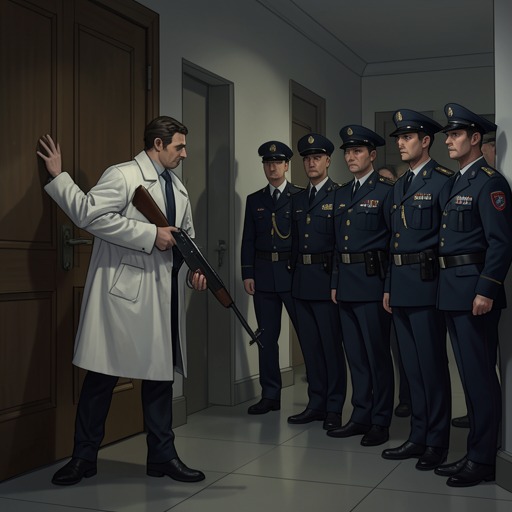
The methods ranged across the body, the senses, and the prisoner’s grasp of time and reality. The researchers used metronomes and serpents, Brechtian vignettes presented at midnight, surgical removal of certain glands, magic-lantern hallucinations, new drugs, threats delivered over hidden loudspeakers, hypnotism, clocks that ran backward, and faces. Hilarius had charge of the faces, a detail that singles out his role within the larger program without making him its sole agent.
Hilarius’s Role and the Experiments’ End
Hilarius recalls the Allied liberators arriving before the researchers could gather enough data. He points to spectacular successes, including Zvi, but says there was little they could demonstrate statistically. The contrast exposes the experimenters’ framing: even within a system that treated prisoners as subjects to be broken, results were measured as data, and a person’s destruction could be counted as a success.
His account gives no further detail about Zvi or the individual results of the experiments. What it does establish is that the program was interrupted before its investigators could complete their evidentiary claims. The episode’s unfinished statistics do not imply an absence of harm; they reveal the narrow terms by which the perpetrators judged what they had done.
Aftermath and Attempted Atonement
Hilarius presents his later work as an attempt to make amends. He says he chose Freud rather than Jung, reasoning that Freud was Jewish, and tried to believe in a world where, once light had been let in, Buchenwald could become a soccer field and its strangling rooms could be repurposed for flower-arranging and solfeggio. In his imagined transformations, Auschwitz’s ovens become ovens for petits fours and wedding cakes, while V-2 missiles become public housing for elves. The grotesque brightness of these replacements shows how desperately he clings to a redemptive vision that can convert sites and instruments of violence into harmless uses.
That effort is described as punishing rather than secure: Hilarius says he slept three hours a night to avoid dreaming and spent the other twenty-one trying to acquire faith by force. He nevertheless concludes that his penance has not been enough. When he tells Oedipa Maas that the dead have come to get him, his confession places the experiments behind his present breakdown: the past is not resolved by his change of profession or his chosen faith, and his account of atonement remains inseparable from fear and self-accusation.